Monday, February 25, 2019

Radio 1 Timeline

Episode Timeline Activity 
We are going to create a timeline of everything that happens in an example of the Radio 1 Breakfast show.  In the exam, you need to be able to explain how the content of the show follows PSB rules and attracts its audience, and will therefore need to refer to real examples from a broadcast.  
Each group will be given a different section of the Radio 1 Breakfast Show to listen to.  The section will be approximately 30 minutes in duration.  Your group must note down everything that happens in your 30-minute section onto the grid.  At the end of the activity you will hand in your grid and your teacher will make a copy of it for the rest of the class.
Here is an example of the detail that you must go into when noting content:
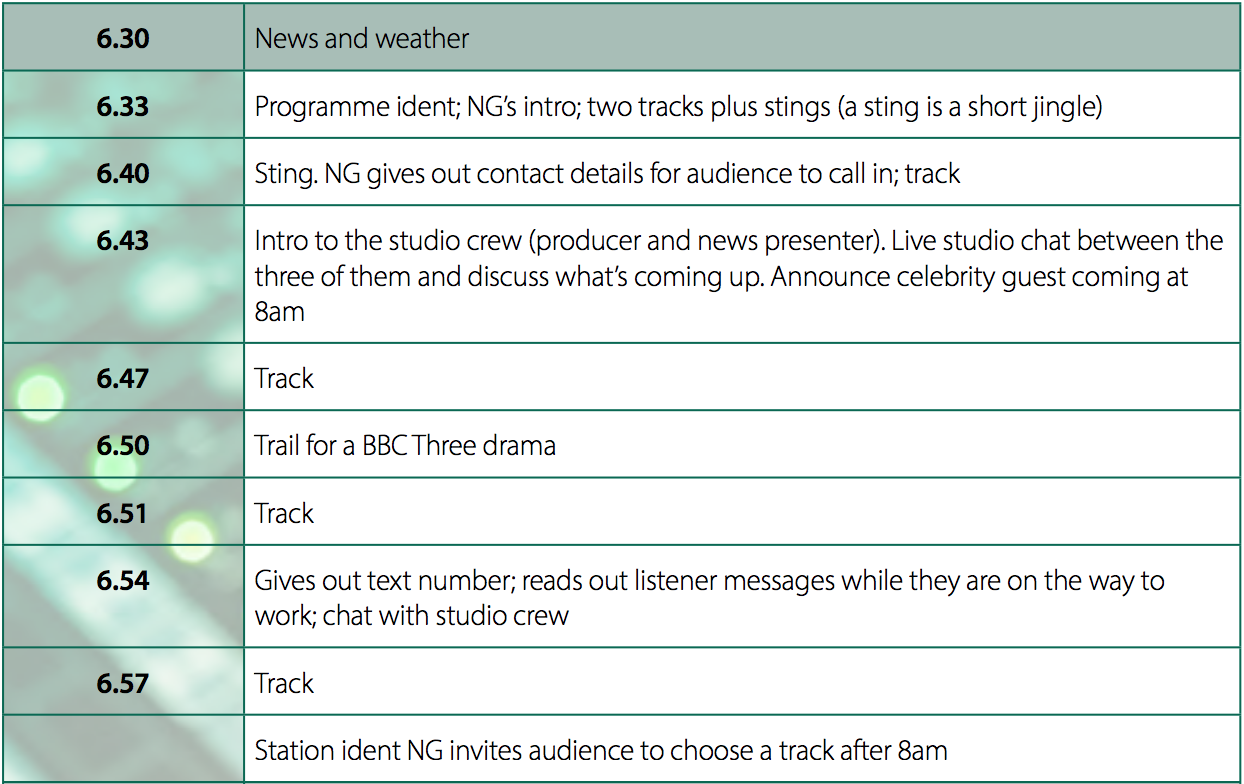
Questions:  
After you’ve identified and written down the content of your section, you must answer the following questions:
  • How does the programme promotes British music?
Radio 1 play up and coming British artists’ songs at times where there is a big audience, which gives the artists a lot of attention. 
  • What percentage of tracks played during your slot were British?
0 
  • What genres of music were played during your slot?  Do a tally.
Pop, Electropop, Hip-Hop/Rap 
  • Celebrity interviews – who is being interviewed and what are they being interviewed about?  How many of the interviews are with British people?
  • News items – list the stories and identify which relate to Britain.  
Stories on Brexit and football.
  • Quizzes and games – what can you win?
Quiz - FA cup tickets
  • How does the broadcast fits into the BBC ethos of ‘informing, educating and entertaining’?
It informs people by showing the news, it educates people through the news and it entertains people through music and involving the audience with quizzes.  
  • How does it differ from commercial breakfast shows?
  • Who you think the audience is from the content of your section?  What evidence do you have for this?
In my section I think the target audience was around 15-30, as it was early in the morning where people would be going to school and work. Also, the person who was quizzed was 30 years old.
  • What platforms is the show is distributed on?
Radios, BBC iPlayer, the BBC website.
List A
List B
List C
Bruno Mars: Finesse
Avelino: 1 in a Million
Dream Wife: Hey Heartbreaker
Camila Cabello: Never be the Same
Big Boi: All Night
Fekky: My Size
Craig David: I know You
Diplo: Get it Right
Hailee Steinfeld: Let Me Go
Eminem: River
Dua Lipa: IDGAF
Jorja Smith: Let Me Down
James Arthur: Naked
G-Eazy & Halsey: Him & I
Kendrick Lamar: All the Stars
Jason Derulo: Tiptoe
HAIM: Nothing’s Wrong
Marmozets: Major System Error
Jax Jones: Breathe
Isaac Gracie: Terrified
Moose Blood: Talk in your sleep
J Hus: Bouff Daddy
Jessie Ware: Your Domino
Paramore: Fake Happy
MK: 17
Justin Timberlake: Filthy
Rae Morris: Atletico
Not3x: My Lover
Liam Payne & Rita Ora: For You
Rudimental: These Days
Ramz: Barking
One Bit & Noah Cyrus: My Way
Sunflower Bean: I was a Fool
Raye & Mr Eazi: Decline
Portugal: Feel it Still
The Vaccines: I Can’t Quit
Sigrid: Strangers
Post Malone: I Fall Apart
Taylor Swift: Gorgeous
Steel Banglez: Bad
Tom Walker: Leave a Light On
SZA & Calvin Harris: The Weekend
Radio One Play List for week commencing 22nd January 2018
Each BBC Radio station has a playlist of songs that it must play every day/week. These songs will be picked to help meet the service licence and mission to promote British talent and to attract the audience.  
Use the grid below to note down the programme contents:

Timing
Content
6:30
Chatty introduction - upbeat music in background.
6:32
interacts with audience by asking them a question - 'tell me all the tat you've got over Christmas'
6:33
give away FA CUP FINAL TICKETS - mentions the quiz for 7:15
6:34
MARK RONSAN AND MILEY CYRUS
6:38
DRAKE - HOTLINE BLING
6:41
Interaction with audiences - reads out responses and replies - chatty dialogue (social media) - requests the audience to swap their foods - starts another social media chain
'ive got loads of bounty and snickers over from Christmas if you are keen for a trade...'
6:42
'today's star listener' - fanfare and gift, giving away an elf on the shelf and some pasta for an 8 year old boy flying to Switzerland on his own - shout out. More replies and responses to audience
6:44
STRAIGHT TO MY HEAD' - YOU ME AT SIX
6:47
more responses coming through - James replies and answers questions - wide audience (massive interaction)
6:49
'PANIC ROOM' - AU/RA + CAMELPHAT
6:52
6:55
6:58
7:00
references yesterdays quiz, more tweets
without me - halsey
feel it still - the man
updates on tweets - more interaction with audience and has final answers for them
How does the programme promotes British music?  
- upbeat, house music in background
- new up to date music every 3/5 minutes
- interacts with the songs
What percentage of tracks played during your slot were British?  
What genres of music were played during your slot?
pop music - current (6:30-7)
rap, pop, electronic (7:00-7:30)
alternative rock, pop, house, indie rock, electronic (7:30-8)
Celebrity interviews – who is being interviewed and what are they being interviewed about?  How many of the interviews are with British people?
there was no interviews in my section however James Gregg asked questions via social media and replied with updates.
News items – list the stories and identify which relate to Britain.  
Quizzes and games – what can you win?
prizes from his office, jam slam give away (super bowl tickets), quizzes (FA Final Cup Tickets). 'today's star listener'
Who you think the audience is from the content of your section?  What evidence do you have for this?
young, interactive audience, roughly 17-29 years old - social media platforms, replies and asks questions. Chatty dialogue between the audience and James Gregg. 
What platforms is the show is distributed on?  
Radios, BBC iPlayer, the BBC website

For any song played you must identify the genre, the name of the artist/band and song, and whether the artist/band are from the UK.
  
Timing
Content
7.00
Greg James intro.
7.01
News, Sport, Weather.
7.05
Songs: The 1975 (English pop band), Cold Water (Major Lazer - American), Sucker Punch (Sigrid - Norwegian)
7.15
Quiz; FA cup tickets.
7.21
Song; Who are you (Anderson .Paak) (American) - Hip-Hop/Rap
7.23
Song; Jonas Blue - Polaroid
7.27
Ariana Grande - thank u, next


Timing
Content
7:30
Sports News / Weather
7:32
Sting. GJ gives out audience details
7:35
That Sound – Sam Fender
7:38
Sunflower – Post Malone ft. Swae Lee
7:41
Radio 1 Jan Slam (Giveaway)
7:42
Chris Stark joins show, mini interview
7:45
Losing It – Fisher
7:47
Sound Of List – Mentions Adele, Sam Smith, Ellie Goulding, Years & Years
7:48
Baby – Clean Bandit
7:52
Snippet of Captain Marvel Trailer
7:53
GJ talks about Camila Cabalio singing to her parrots. Discusses Sesame Street too.
7:54
Feels – Calvin Harris ft. Katy Perry, Pharrell Williams, Big Sean
7:57
Joke about Brexit
7:57
Homesick - Catfish and the Bottlemen
How does the programme promote British music?  
The programme promotes British music because it talks about successful British artists such as Adele, Sam Smith, Ellie Goulding etc. as well as plays a few British songs.
What percentage of tracks played during your slot were British?  
1/6 of the tracks were British
What genres of music were played during your slot?
pop music - current (6:30-7)
rap, pop, electronic (7:00-7:30)
alternative rock, pop, house, indie rock, electronic (7:30-8)
Celebrity interviews – who is being interviewed and what are they being interviewed about?  How many of the interviews are with British people?
Interview with another Radio 1 host, Chris Stark, and talked about the Jan Slam giveaway for the football tickets.
News items – list the stories and identify which relate to Britain.  
The Super bowl and football was talked about, with football obviously relating to the U.K but also dipped into US players.
Quizzes and games – what can you win?
prizes from his office, jam slam give away (super bowl tickets), quizzes (FA Final Cup Tickets)
Who you think the audience is from the content of your section?  What evidence do you have for this?
young, interactive audience, roughly 12-29 years old – as when Gregg James done the sting, people as young as 12 were listening as well as teachers and other workers, either on the way to school or work.
 What platforms is the show is distributed on?  

Radios, BBC iPlayer, the BBC website

Radio Audiences & Technology


Friday, February 15, 2019

BBC Essay

BDRC Continental research agency done a research on the whole of the BBC Radio 1 & 2 shows. The research shows only a third (35%) said that BBC Radio informs and educates the public. 36% simply identified the stations with playing the most popular music. Listeners were asked about specific associations and reasons why they listened to Radio 1, which resulted in listeners saying: 6% said that they associated the station with documentaries and social action, 26% said that they associated the station with accurate and impartial news coverage, 25% said that they associated the station with this programming for younger teenagers. The Radio 1 target audience is people aged under 29 years of age, BUT 30% of 35-44 year olds think it is aimed at them. BBC Radio 1 Breakfast show mainly targets a range of young listeners, using a mix of music tracks and speech/talks. This is what entertains and engages the audience to listen. The target audience is 15-29 year olds, sometimes targeted at younger teenagers for the songs played.

Throughout our certain sections that we listened to, we found that a high percentage of the songs were British artists and many of the various competitions such as: Tickets to the FA Cup, Cricket World, hang out with The 1975 and Little Mix. Also on Radio 1 Breakfast Show there are no adverts so it’s non stop tracks and discussions to keep the audience entertained. The BBC Radio 1 website consists of the latest music tracks (a way of listening to them - which are updated frequently). It also includes live music and mixes, such as live lounge, where artists sing covers of other people’s songs; the official chart, Radio 1 playlist, ‘what’s new’, news, sport, weather, iPlayer, sounds etc.

Analysed podcast: “A journey back into fake britain” - Greg James plays a game by ringing lots of callers and firing random questions, in which they have to respond with the first thing that comes into their head without panicking or thinking too much. The idea is that the person on the end of the phone is under pressure, which makes it more entertaining for the listeners. An example of the sort of questions are: what noise does a koala make? Or a happy butterfly? These questions are unusual which engages the audience because Greg James can be known as a fun, younger guy, friendly, like your best mate - very likeable.
Another part of the podcast presents him asking viewers what they listen to, to help them fall asleep. This is effective in receiving more listeners because it shows that the radio presenter has an interest in what their fans like and dislike. People want to get involved because Radio 1 is listened to by a wide target audience. Greg James had been promoted to the Radio presenter for the morning breakfast show. This is due to the fact that Nick Grimshaw's audience figures had dropped whilst he was still the presenter. Radio 1 figured using Greg James in the morning would increase the amount of viewers - which is exactly what happened. He is very popular with the audience and this is consequently shown through his social media…

When researching Greg James’ social media, I had seen that he had posted a screenshot of a BBC news article stating ‘Rajar figures: Greg James boosts Radio 1 breakfast audience by 230,000’. This suggests that people would rather listen to Greg James presenting that when Nick Grimshaw did. He also posts humorous images and tweets across all of his social media. Some posts are duplicated across a few different types of social accounts, such as Instagram and Twitter for example. A reason for this could be if some viewers don't have a certain type of social media due to preferences of how it works or is set out.

This year the event is in Swansea and contains acts such as ;Craig David, Niall Horan, Wolf Alice, Ed Sheeran and Taylor Swift. These well known artists attract radio’s young audience and also attracts others who are not listeners of radio 1. Therefore, this event can attract new listeners who would be persuaded by the good artists in the line up. This event is said to be as good as Glastonbury since the line up is very popular.

News Analysis of News Covers


Image result for the sun front covers
THE SUN - MAY 6TH2015

Audience
The Sun, a tabloid, targets an audience of a middle/working class, therefore relating to the C2DE social class categories. Predominantly this is to be aimed at the UK citizens who like to follow a bit of politics, but want a more gossipy side to it. 

Article Topic / Main Points 
The title ' SAVE OUR BACON' is presenting Ed Miliband in an embarrassing way by using an unflattering photo of him. The front page that Ed Miliband is way by emphasising   


Image result for the guardian front page

BBC Radio 1 Questions

How old is the BBC?
The BBC first began on 18th October 1922 and so it is 96 years old. 


Who is Lord Reith and what connection does he have with the BBC?
John Reith (1889-1971) was the founder of the BBC.  Lord Reith was the BBC's first general manager . He was commended when he fought off the politicians' attempts to influence the BBC, while offering the British people programmes to educate, inform and entertain. But in a working life that stretched over 60 years. Reith began the BBC at the young age of 16.


When did it start broadcasting Radio 1?

30 September 1967. It was hosted by Tony Blackburn.


What are the BBC’s five Public Purposes, as set out in the Royal Charter?

To provide impartial news and information to help people understand and engage with the world around them
To support learning for people of all ages
To show the most creative, highest quality and distinctive output and services
To reflect, represent and serve the diverse communities of all of the United Kingdom’s nations and regions and, in doing so, support the creative economy across the United Kingdom
To reflect the United Kingdom, its culture and values to the world

What is the BBC’s Mission?

 The BBC mission is to inform, educate and entertain the population of the United Kingdom.

What is the BBC’s Vision?
The BBC’s vision is to be To be the most creative organisation in the world.

What are the BBC’s values?

Trust is the foundation of the BBC: we are independent, impartial and honest.

Audiences are at the heart of everything we do.
We take pride in delivering quality and value for money.
Creativity is the lifeblood of our organisation.
We respect each other and celebrate our diversity so that everyone can give their best.
We are one BBC: great things happen when we work together.


What does the licence fee cover? 

 The UK is buying more TV Licences than ever1. This income means all licence payers can enjoy an ever-wider choice of BBC shows and services, free at the point of use, on a range of platforms.


By buying a licence you support the creation of BBC programmes and services, and new ways of bringing them to you. Our purpose is to ensure as much of the fee as possible goes towards funding them.


Even though the ways we watch and listen are changing, the licence fee also allows the BBC's UK services to remain ad-free and independent.

How is the BBC regulated?  How long as this body regulated the BBC and who regulated it before? 


The Office of Communications (Ofcom) is the UK’s broadcasting, telecommunications and postal regulatory body. Under the BBC’s Charter it has responsibility for regulating the BBC. It does this through an Operating Framework and by setting a license for the BBC that contains the regulatory conditions the BBC is required to meet. Ofcom also assesses performance, ensures fair and effective competition and regulates how the BBC’s commercial activities interact with its public services. In addition, it regulates BBC content and output against its Broadcasting Code. Ofcom has been regulating the BBC since April 2017.

Tuesday, February 5, 2019

Jungle Book Interview


Reflection

What was the task you were assigned?
Our task was to re-create a an interview of the producer and the marketing manager of the 2016 Jungle Book re-make. We had to incorporate key information and stats about the film to help revise for, for future examinations.
What programme did you use to complete your task? 
To edit our interview we used the editing software that is Abode premiere pro, with this software we used to editing tools to help use the green screen to add various layers and images to the background, also other clips such as the trailer was put into place over our original audio and film.
What tools/effect did you use from your programme to create your task?
We used the ultra key to add images to the original audio, this then replaced the green screen background with images from the film to help entice the audience to watch the film.
What were the biggest obstacles to completing your task?
The most difficult part was probably filming all the characters to look at similar eye lines, as i as the interviewer was speaking on my own in one shot while the producer and marketing manager were based in another shot looking in another direction to the camera. This was done to allow a realistic view of an interview.
Did you complete the task on time?
We completed the task on time, as we utilized our time by effectively planning and spreading the work evenly between the whole group. This allowed the work to be completed to the date required.
How do you think this task will help with your Jungle Book revision?
Personally i believe that this will help me remember and revise in the future, as it is an alternative to tedious book work, therefore this variety has created a memory that has been stored that can be recollected easily. 
What do you think you could have improved in terms of content and presentation?
Personally, I believe that the quality of my work has improved drastically as i am now familiar with various programs and functions within the media world. Therefore, i now work more effectively and efficiently to the deadline and with a group. My presentation has become cleaner due to vaster editing knowledge due to repetition and practice.
What was your initial feedback? What did others say about your production?
Other companions seemed to enjoy and like our work, this then helped me to recollect the effort put in to create a successful interview that was completed to the deadline.
Identify what went well and with hindsight what would you do differently?
I believe that most of our work was done to an acceptable standard, however if i was to create this task again them i would spend more time editing our work to add more effects and cleanliness to our clips so they would run slightly more smoothly without a space between speech.